
Paper Business Cards Are Dead
The environmental, economic, and practical case for digital business cards in 2026 and beyond.
Keynodex Marketing Team
Marketing Team
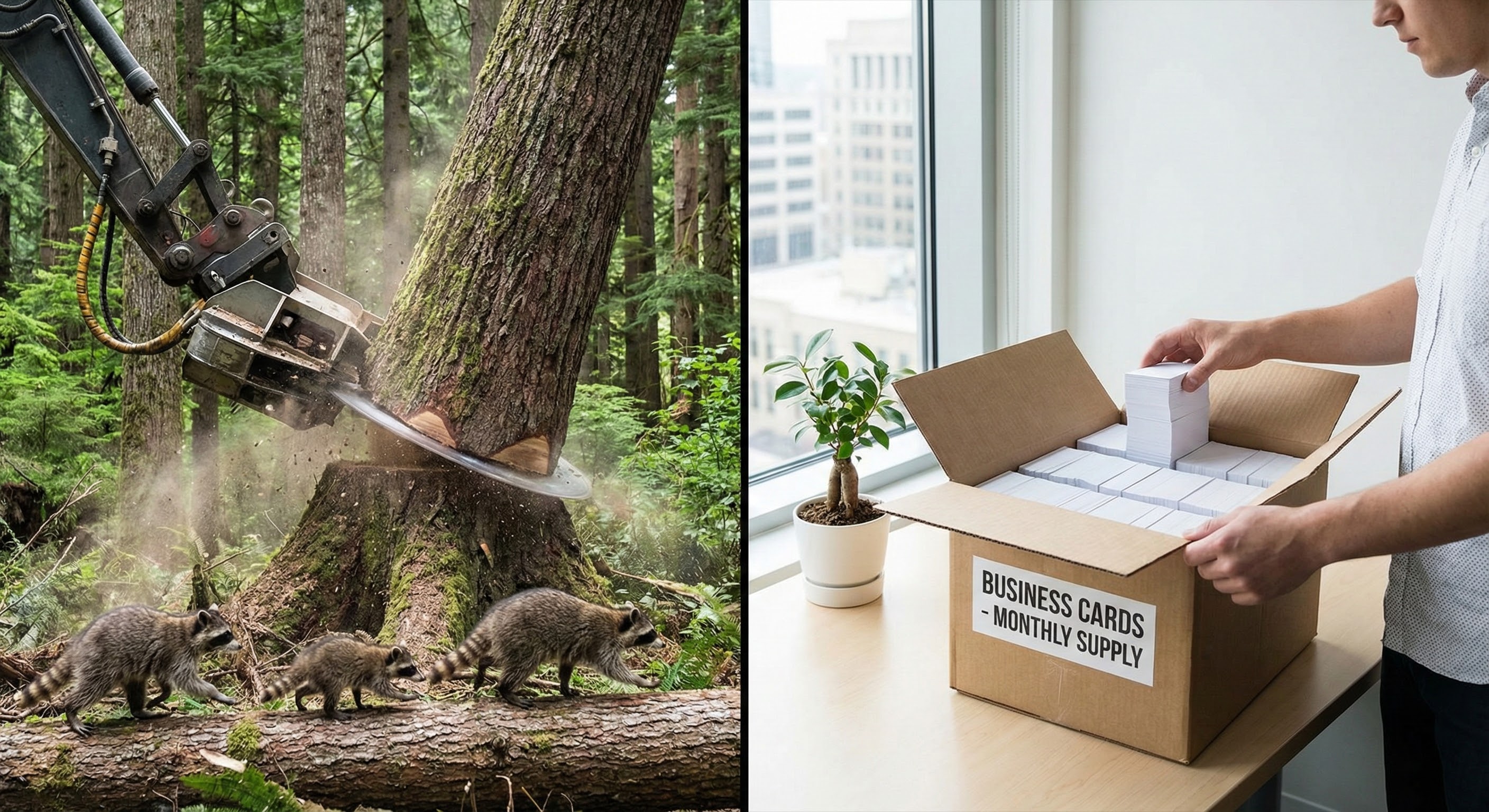
A Technology Whose Time Has Passed
The business card was invented in 17th century Europe. For 400 years, it was the gold standard of professional introduction.
But in 2026, it's a relic.
Not because business cards stopped working - they never really worked that well. We just didn't have better options. Now we do.
The Numbers Don't Lie
Let's start with the uncomfortable statistics:
- 10 billion business cards are printed globally every year
- 88% are thrown away within a week
- 7 million trees are cut down annually for business card production
- $30 billion is spent on cards that end up in landfills
Think about that: we're destroying forests to create paper rectangles that people immediately throw away.
The Environmental Cost
By the Numbers
A single standard business card has a surprisingly large environmental footprint. Per 1,000 cards: 0.05 trees, 22 gallons of water, 4.4 lbs of CO2, and 2.2 lbs of waste (88% become trash).
For a professional who goes through 1,000 cards per year, that's the equivalent of:
- Driving 500 miles in a car (CO2)
- Running a washing machine 11 times (water)
- 2+ pounds of landfill waste
Multiply that by millions of professionals, and you have an environmental crisis hidden in plain sight.
The Reprint Problem
Here's what makes it worse: business cards become obsolete.
- Got a new job title? Reprint.
- Changed phone numbers? Reprint.
- Updated your LinkedIn URL? Reprint.
- Switched companies? Throw out the old ones, print new ones.
The average professional reprints their business cards 2-3 times per year. That's 2-3x the environmental impact.
Digital cards update instantly. Forever.
The Economic Reality
The True Cost of Paper Cards
Most people only consider the printing cost. But the real expenses include:
- Printing (500-1000 cards): $50-200
- Design/redesign: $100-500
- Reprints (avg 2.5x/year): $125-500
- Storage/organization: $50 (time value)
- Lost opportunities (88% waste): Incalculable
Total: $325-1,250+ per year
And that doesn't account for the connections you lost because someone threw your card away before following up.
The Digital Alternative
KeynodeCard pricing:
- Free tier: $0/year (unlimited sharing)
- Pro tier: $12/month ($144/year for advanced features)
Even at Pro pricing, digital cards cost less than paper - and the connection rate is 7x higher.
The Practical Problems with Paper
1. They're Never There When You Need Them
How many times have you said: "I don't have my cards on me"?
Your phone is always with you. Your QR code is always accessible.
2. They Go Stale
Paper cards are printed at a moment in time. The moment your information changes, every card in circulation becomes inaccurate.
Digital cards update everywhere, instantly.
3. They're One-Dimensional
A paper card holds:
- Your name
- Your title
- Your company
- Maybe a phone number and email
- A LinkedIn URL that no one will type
A digital card holds:
- All your social profiles
- Your bio and photo
- Links to your portfolio
- Direct action buttons (call, email, follow)
- Analytics on who viewed your profile
4. They Create Work, Not Connections
Paper cards require follow-up:
- Receive card
- Store card somewhere
- Find card later
- Manually enter contact info
- Search for them on social media
- Send connection request
- Hope they remember you
Digital cards create instant connections:
- Scan QR code
- Tap follow
- Done
The Generational Shift
Here's a telling statistic: 73% of professionals under 35 prefer digital contact exchange.
For Gen Z entering the workforce, paper business cards feel as outdated as fax machines. They've never known a world without smartphones, QR codes, and instant connections.
The question isn't whether the shift will happen. It's whether you'll lead it or follow it.
Making the Switch
Ready to go digital? Here's how to transition smoothly:
Step 1: Create Your Digital Card
Set up your KeynodeCard in under 2 minutes. Add your photo, bio, and all your social profiles.
Step 2: Add Your QR Code to Your Phone
Save your QR code to your home screen. You can also add it to your phone's wallet app for instant access.
Step 3: Use Up Your Paper Cards (Optional)
If you have cards left, use them - but add your QR code as a sticker or write your KeynodeCard URL on the back. Best of both worlds during the transition.
Step 4: Track Your Results
KeynodeCard shows you who viewed your profile and when. You'll see immediately how much more effective digital networking is.
The Future Is Already Here
Paper business cards had a good run. Four hundred years of service.
But in a world where:
- Everyone has a smartphone
- QR codes are universal
- Sustainability matters
- Time is precious
- Connections drive careers
...paper cards simply can't compete.
Digital doesn't get thrown away.
It doesn't go stale. It doesn't run out. It doesn't require follow-up. It doesn't hurt the planet.
It just works.
The Bottom Line
Every paper card you hand out has an 88% chance of ending up in the trash.
Every digital card you share has an 87% chance of becoming a real connection.
The math is simple. The choice is clear.
Paper gets trashed. Digital doesn't.
Related Articles
- Stop Spelling Your Handles - Why QR codes beat spelling out usernames at networking events.
- Why You Lose Connections After Networking Events - The psychology behind the follow-up gap.
About Keynodex Marketing Team
The Keynodex Marketing Team creates technical content, industry insights, and best practices guides to help developers and businesses build better software systems.
View all posts →Try KeynodeCard
Share your professional profile instantly with a single scan. No app required.
Related Articles
 Networking
Stop Spelling Your Handles
Why manually sharing social media handles is costing you connections, and how one QR scan changes everything.
 Networking
Why You Lose Connections After Networking Events
The psychology behind lost connections and how instant digital follow-up is changing professional networking forever.